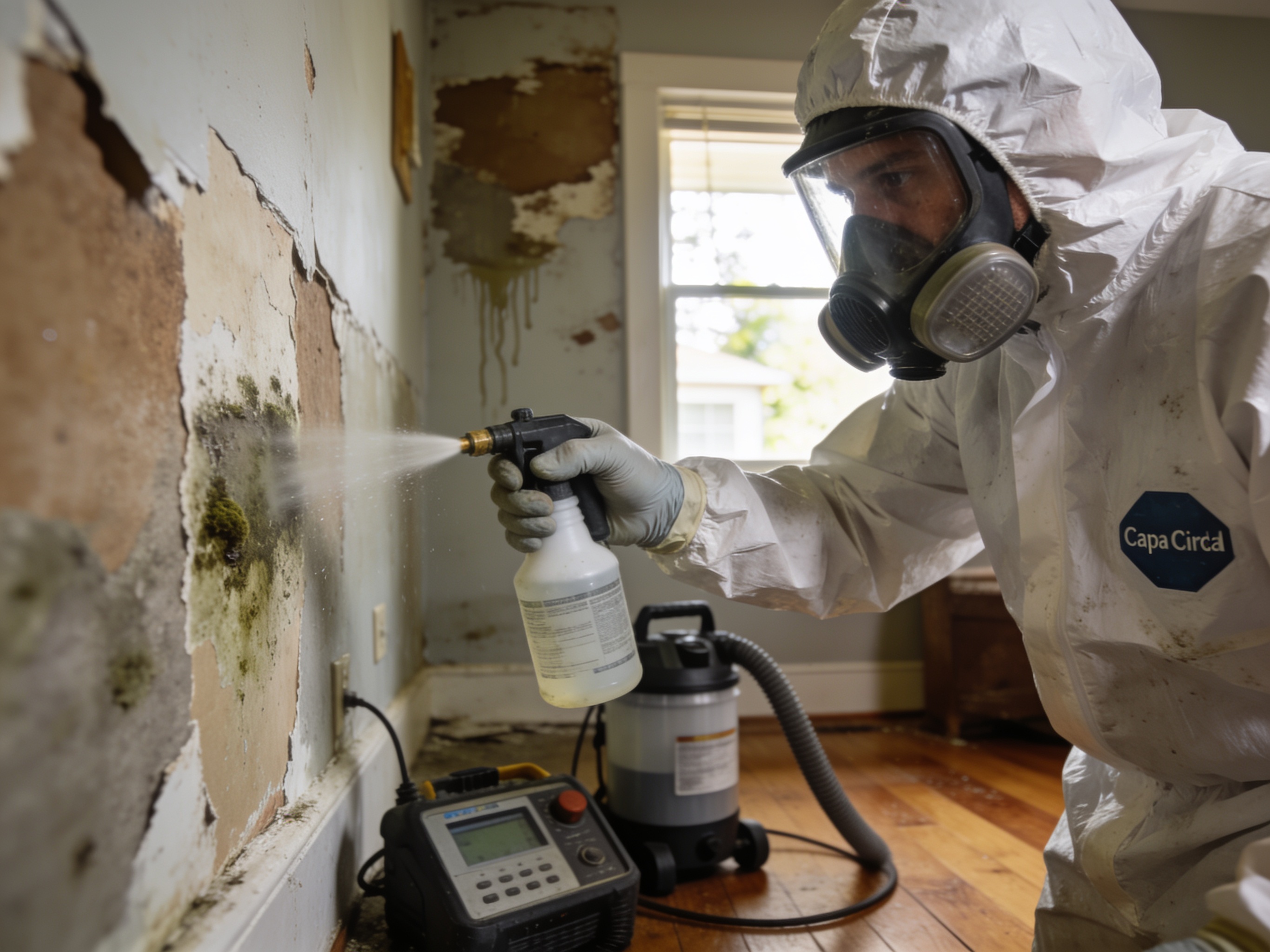
Cape Coral's older single-story homes built before 1990 in Downtown Cape Coral and Cape Coral Isles often have wood framing and fiberglass insulation that trap moisture after roof leaks or AC condensation. High summer humidity combined with dry winters creates repeated wetting and drying cycles that push mold deep into drywall seams and under baseboards. Technicians must pull affected materials back at least 18 inches beyond visible growth and run commercial dehumidifiers for several days to drop indoor moisture below 50 percent before any reconstruction.
Lee County building codes require negative air pressure during removal on larger jobs to prevent spores from drifting into unaffected rooms, especially in slab-on-grade homes common near the Cape Coral Yacht Club. Post-hurricane flooding from nearby Fort Myers and Sanibel can leave standing water under kitchen cabinets and in crawl spaces for days, leading to hidden colonies that only surface weeks later. Homeowners who attempt bleach cleaning on porous surfaces like drywall or carpet padding usually see regrowth within a month because the roots remain.
Burnt Store area properties near canals face additional challenges from salt air corrosion on metal HVAC components, which creates condensation points that feed mold on nearby ductwork. Remediation crews use HEPA air scrubbers and antimicrobial coatings rated for Florida's coastal environment, then document moisture readings at multiple depths in the substrate before clearance testing. Skipping the final verification step often results in insurance carriers denying subsequent claims when the same strain reappears after the next rainy season.
Technician insight
In Cape Coral, the thing that catches most people out with Mold Remediation is the way summer humidity keeps re-wetting wood framing in 1970s and 1980s homes in Cape Coral Isles even after the original leak is fixed, so crews must run dehumidifiers longer than homeowners expect.
Hidden Mold After AC Leak in Cape Coral Isles
A homeowner noticed musty odors near the master bedroom closet after an air handler drip. Inspection revealed mold behind the drywall extending into the adjacent wall cavity. Crews removed the affected sections, dried the framing for four days, and applied antimicrobial coating before reinstalling new drywall.
Mold Remediation Services We Offer
✓Attic Mold Remediation
Remove mold from rafters and insulation in Cape Coral homes where poor attic ventilation meets summer humidity, then improve airflow to prevent recurrence.
✓Bathroom and Shower Mold Removal
Treat tile grout, drywall behind showers, and vanity areas common in Cape Coral Isles properties where constant moisture from daily use combines with high ambient humidity.
✓Post-Flood Mold Treatment
Address mold growth after storm surge or heavy rain in Lee County neighborhoods like Burnt Store, including extraction from under cabinets and subfloor drying.
✓HVAC Duct Mold Cleaning
Clean and sanitize ductwork in older Cape Coral homes where AC condensation and salt air create mold colonies that spread spores through the entire living space.
✓Crawl Space Mold Remediation
Encapsulate and treat mold in raised-floor homes near the Cape Coral Yacht Club where ground moisture and limited airflow allow colonies to form under living areas.
Mold Remediation Cost in Cape Coral, FL
| Service | Typical Range | What Affects It |
|---|---|---|
| Small visible area under 10 sq ft | $450–$900 | Bathroom or closet; price rises if drywall must be removed behind tile. |
| Whole-room remediation | $1,200–$2,800 | Includes containment and multi-day drying in typical Cape Coral single-story homes. |
| Attic or crawl space job | $1,800–$4,500 | Depends on access and whether insulation replacement is required. |
| Post-flood hidden mold | $2,500–$6,000 | Multiple rooms after water intrusion from Lee County storms. |
Ranges are typical for Cape Coral, FL and confirmed with an exact written quote before any work starts.
How it works
- 1
Initial Moisture Mapping
Use meters and infrared cameras to locate hidden moisture in walls, ceilings, and floors throughout the affected Cape Coral property.
- 2
Containment Setup
Install plastic barriers and negative air machines to isolate the work zone and protect the rest of the home from spore migration.
- 3
Material Removal
Cut out and dispose of mold-affected drywall, insulation, and trim while HEPA vacuuming surfaces to capture loose spores.
- 4
Drying And Antimicrobial Application
Run industrial dehumidifiers and air movers until moisture readings stabilize, then apply EPA-registered treatments to remaining surfaces.
- 5
Clearance Testing
Perform independent air and surface sampling to confirm mold levels have returned to normal before any reconstruction begins.
Pricing
Pricing varies by square footage, depth of growth, and whether hidden damage exists behind cabinets or in attics common to Cape Coral's older stock.